AI Layoffs: What’s Really Happening Beneath the Headlines

If you read the news, it’s easy to come away with a simple — and alarming — conclusion:
AI is taking jobs.
But after reviewing recent layoffs across tech, finance, logistics, media, and healthcare, that explanation turns out to be incomplete. In many cases, it’s not even the most important part of the story.
The reality is more nuanced, and understanding it matters — especially for executives, managers, and professionals trying to plan for what comes next.

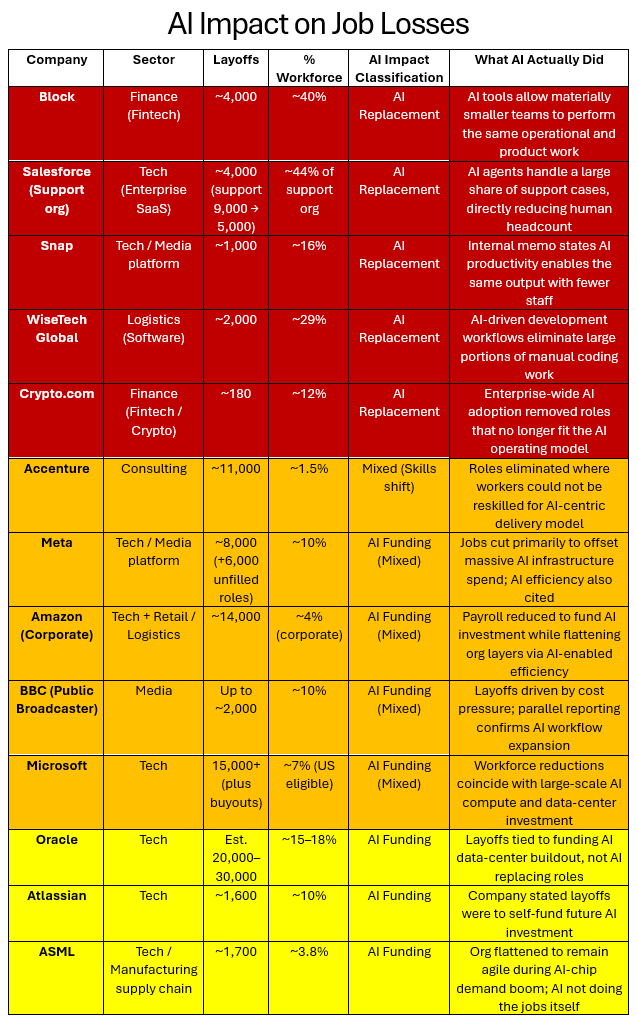
Not All “AI Layoffs” Are the Same
When companies announce job cuts and mention AI, they’re usually talking about one of four very different dynamics. Lumping them together obscures what’s actually happening.
1. AI Replacement: When the Work Is Truly Automated
This is the clearest and most direct case. Here, AI already performs a meaningful portion of the work, allowing companies to operate with fewer people while maintaining the same output.
Recent examples include:
Customer support organizations where AI agents now handle a large share of tickets
Operations and workflow teams where automation absorbs repetitive tasks
Software environments where AI-assisted development dramatically reduces manual effort
In these cases, headcount reductions reflect real productivity substitution, not just future plans. The impact is currently concentrated, but it is genuine.
2. AI Funding Layoffs: Payroll Reduced to Pay for Compute
This is the largest and most misunderstood category.
In many high-profile layoffs, AI is not replacing the affected jobs at all. Instead, companies are cutting roles to free up capital for:
Data centers
GPUs and cloud compute
AI infrastructure and specialized talent
Put plainly, organizations are reallocating budgets from people to silicon.
The work still exists. The roles are gone because AI is expensive — and budgets are finite.
3. Mixed Cases: Efficiency Gains and Investment Pressure Together
Some companies are more candid. They acknowledge that:
AI is improving efficiency and reducing the number of people required in certain areas, and
Scaling AI requires massive upfront and ongoing investment
These organizations are simultaneously pursuing higher productivity and reshaping their cost structure to support AI-first operations. For many large enterprises, this hybrid model is becoming the default.
4. AI‑Adjacent Layoffs: Technology Change Without Explicit AI Claims
In sectors like banking, logistics, and healthcare, layoffs are often described using language such as:
“Technology efficiencies”
“Transformation initiatives”
“Operating model changes”
AI may be part of the broader context, but it is not explicitly cited as the cause. These cases should not be counted as confirmed AI-driven displacement — at least not yet.
The Bigger Pattern: This Is a Budget Story
What emerges across industries is not an AI apocalypse, but a capital reallocation event.
AI changes the economics of organizations:
Fewer people are needed per unit of output
Fixed costs rise sharply due to infrastructure investment
Remaining roles carry more leverage and responsibility
Even before full automation arrives, these shifts affect hiring, promotions, and job stability.
What This Means for Leaders and Professionals
The most important question is no longer:
“Will AI replace my job?”
A better question is:
“Does my role still make sense in an AI‑first cost structure?”
Right now, roles most exposed tend to involve:
Repetitive knowledge work
Support and operations
Layers of coordination and middle management
Roles gaining resilience are those that:
Design, integrate, govern, or supervise AI systems
Translate between business reality and technical capability
Own outcomes rather than tasks
A Clearer Way to Talk About AI and Jobs
Treating every layoff as “AI replacement” oversimplifies what’s happening — and makes it harder to respond intelligently.
Understanding how AI is influencing job losses — whether through direct automation, funding pressures, or broader restructuring — gives leaders and workers a more realistic framework for navigating the transition ahead.
The future of work isn’t being decided by a single breakthrough moment. It’s being shaped quietly, through budgets, operating models, and incremental choices about where organizations invest.
That’s where the real signal is.